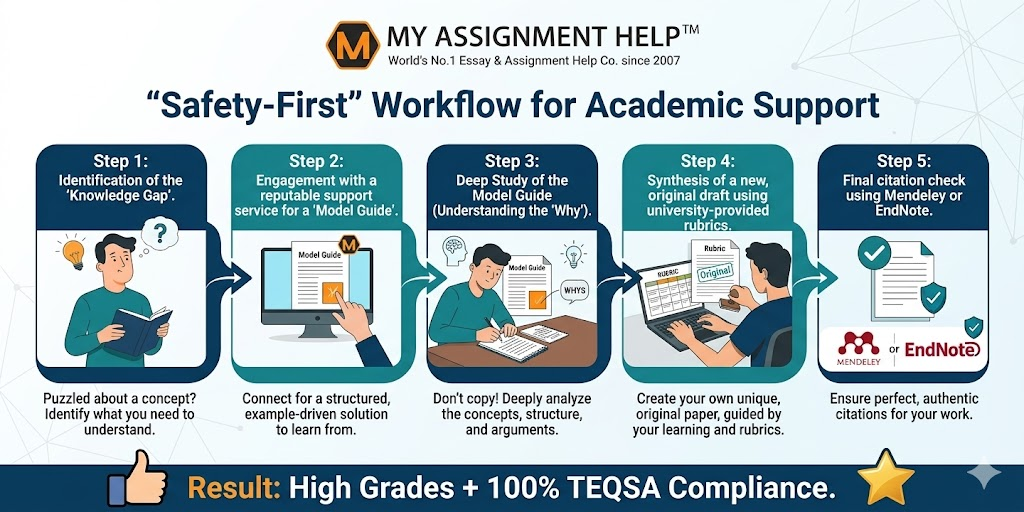
The Australian higher education landscape is currently navigating one of its most transformative eras. Following the final report of the Australian Universities Accord in 2024, the focus has shifted from mere “detection” of academic misconduct to a “culture of integrity.” For the 1.6 million domestic and international students enrolled across the country—from the University of Sydney to UWA—staying on the right side of the law is more complex than ever.
As of 2026, the Tertiary Education Quality and Standards Agency (TEQSA) has refined its regulatory stance to address the “gray areas” of student support. For students looking for assignment help to manage the crushing weight of modern degree requirements, the question is no longer “Should I get help?” but “How do I get help while protecting my academic record?”
The Anatomy of the TEQSA Framework (2024–2026)
To understand how to use support services safely, one must first understand the regulator. TEQSA doesn’t just make “suggestions”; it enforces the Higher Education Standards Framework (Threshold Standards) 2021.
The 2024 “Disruption” Milestone
In 2024, TEQSA reached a milestone by blocking over 400 illegal contract cheating websites through collaboration with Australian ISPs. This was a clear signal: the government is no longer just punishing students; they are hunting the providers. However, this has led to a surge in “underground” or “predatory” services that use encrypted messaging apps to target students.
Why the “Accord” Matters
The 2024 Universities Accord mandated that institutions must provide better support for students. This has actually created a space for legitimate academic assistance. When a student uses a service for concept clarification or structural guidance, they are engaging in a form of “supplementary learning” that the Accord actually encourages to bridge the equity gap.
Defining the “Integrity Spectrum”
The biggest mistake students make is thinking academic integrity is a binary “Yes/No” issue. In reality, it is a spectrum.
The White Zone: Peer Review & Tutoring
This includes university-run writing centers and private tutoring. This is 100% compliant.
The Green Zone: Consultative Support
This is where professional assignment help lives. Here, a student provides a prompt, and a specialist provides a model response or a conceptual breakdown. The student uses this to learn the topic and then writes their own assignment from scratch.
The Amber Zone: Poor Practice
This is unintentional plagiarism—forgetting a citation or “patch-writing” (changing every third word of a source). While not usually criminal, it can lead to failed units at Group of Eight (Go8) universities.
The Red Zone: Contract Cheating
This is the intentional outsourcing of work. As of 2026, TEQSA uses advanced stylometry—a digital fingerprinting technique—to verify that the person who wrote the Week 2 quiz is the same person who wrote the Week 12 essay.
STEM-Specific Integrity: A Focus on Organic Chemistry
STEM students face a unique set of challenges. Unlike humanities, where “opinion” plays a role, STEM subjects like Chemistry require rigid adherence to synthesis protocols and reaction mechanisms.
The complexity of carbon-based compounds often leaves students feeling isolated. This is why organic chemistry assignment help has become one of the most searched-for academic terms in Brisbane, Melbourne, and Adelaide.
Case Study: The “Synthesis” Barrier
In a 2025 survey of Australian science undergraduates, 64% reported that they considered withdrawing from their degree specifically due to the difficulty of Organic Chemistry II. When a student seeks organic chemistry assignment help, they aren’t looking for a shortcut; they are looking for a visual translation of a 3D molecular problem.
How to stay compliant in Chemistry:
- Request a “Methodology Breakdown”: Ask the service to explain why a specific reagent was used in a synthesis.
- Verify the Data: Use the provided guide to check against your own lab results.
- Draw Your Own Mechanisms: Never copy-paste a digital chemical structure; redraw it to ensure you understand the electron flow.
The 2026 Detection Ecosystem
If you are a student in 2026, you are being monitored by more than just a simple plagiarism checker.
AI-Detection and “Human-in-the-Loop”
The 2024 “AI Scare” led to the development of sophisticated tools that don’t just look for AI text, but for “lack of human error.” Ironically, writing that is too perfect is now a red flag for Australian tutors.
Metadata Analysis
Universities now check the “Properties” of your submitted Word or PDF files. If the “Author” of the document isn’t you, or if the “Total Editing Time” is only 2 minutes for a 2,000-word essay, an integrity investigation is automatically triggered.
Data-Driven Insights: The Cost of Misconduct
The financial and personal cost of an integrity breach in Australia is staggering.
| Penalty Type | Immediate Impact | Long-term Consequence |
| Formal Warning | Zero marks for the unit. | Stays on your internal record; loses “Good Standing” status. |
| Suspension | 6–12 months away from study. | For international students, this triggers a CoE cancellation and potential visa revocation. |
| Expulsion | Permanent removal from the university. | You may be “blacklisted” from enrolling in other Australian HE providers for a period. |
How to Identify a “Predatory” vs. “Professional” Service
As a senior strategist in the education space, I advise students to look for these “Red Flags” when choosing a service:
- Red Flag: The service promises a “Guaranteed High Distinction.” (No legitimate educational service can guarantee how a specific professor will grade).
- Red Flag: They ask for your university portal login.
- Green Flag: They provide a comprehensive About Us section with real subject-matter experts.
- Green Flag: They focus on samples and tutoring rather than “doing your homework.”
Strategic Advice for International Students
For the nearly half-million international students in Australia, academic integrity is a migration issue. Under the National Code 2018, providers must report changes to a student’s enrollment. An integrity breach that leads to exclusion will be reported to the Department of Home Affairs.
By using assignment help as a bridge to understand Australian marking rubrics (which are often very different from those in China, India, or the UK), you can avoid the accidental plagiarism that often plagues first-year international students.
Key Takeaways for the 2026 Academic Year
- Knowledge is Power: Understand your university’s specific “Student Integrity Policy”—they vary slightly between RMIT, Curtin, and Griffith.
- The “TEQSA Block” is Protective: If a site is blocked by your ISP, do not use a VPN to access it; those sites are blocked because they are often associated with identity theft.
- STEM Requires Strategy: Don’t let the difficulty of science lead you to poor choices. Use specialized organic chemistry assignment help to master the logic of the subject.
- The “Vibe Check”: If a service feels “salesy” or unethical, it probably is.
See also: How Technology Is Changing Education
Frequently Asked Questions (FAQ)
Q1: Can TEQSA take away my degree after I graduate?
Yes. If evidence of contract cheating surfaces even years after graduation, Australian universities have the legal right to revoke a degree. This occurred in several high-profile cases in 2023–2024.
Q2: Is using AI the same as contract cheating?
It depends on your university’s policy. Most Australian institutions now allow “generative AI” for brainstorming or outlining, but submitting AI-generated text as your own is considered “Academic Misconduct.”
Q3: How do I cite a tutor or an assignment help service?
Generally, you don’t cite them in your bibliography, as they are considered “personal communication” or a “study aid.” However, you should acknowledge in your notes if a specific concept was clarified by a tutor.
About the Author: James Sterling
James Sterling is a Senior Academic Consultant and Lead Content Strategist at MyAssignmentHelp.services. With a Master’s degree in Higher Education Policy and over a decade of experience navigating the Australian tertiary sector, James is a leading voice on student success. He has consulted for various educational tech firms to ensure their services align with TEQSA’s Higher Education Standards Framework. James is a regular contributor to AU education forums and is a staunch advocate for “Ethical Tutoring” as a means of reducing student burnout.
References & Data Sources
- TEQSA (2024): Annual Report on ISP Blocking of Illegal Cheating Services.
- Australian Universities Accord (2024): Final Report – Recommendations on Student Support and Equity.
- Journal of Academic Ethics (2025): “The Evolving Nature of Contract Cheating in STEM: A Study of Australian Undergraduates.”
- Higher Education Quality Council (2026): National Statistics on Academic Integrity Trends.
- Department of Education (AU): Guidelines for International Students on Academic Conduct.