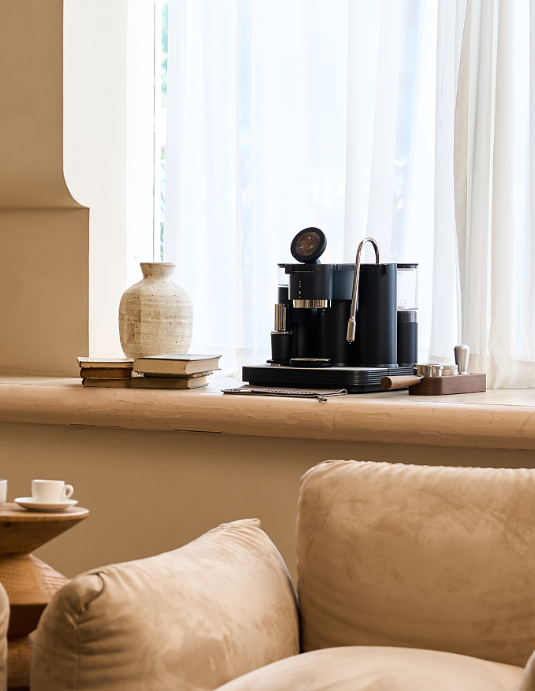
Walk into a good café and the espresso seems effortless. The barista works quickly, the milk is silky, and the cup that arrives tastes balanced and rich. It is easy to assume that the secret is an enormous, expensive commercial machine, and that home coffee will always be a pale imitation. In reality, much of what makes café espresso good has little to do with size or price. It comes down to a few fundamentals done consistently: fresh beans, an even grind, stable temperature, the right dose, and milk steamed with care. Get those right at home, and the gap narrows dramatically.
What “professional-style” really means
The phrase is often used loosely in marketing, but it has a practical meaning. A professional-style setup is one that gives you control over the variables that matter, and then helps you repeat a good result. That means a grinder that can be adjusted finely enough for espresso, a machine that holds its brewing temperature steady, and a way to dose accurately rather than guessing. It does not mean you need a machine built for a hundred drinks a day, with plumbing, three-phase power, and a footprint the size of a small fridge.
Commercial machines are designed for volume and speed under constant use. At home, you might make two to four drinks a day, often with pauses in between. A machine built for that rhythm can actually perform better for you, because it warms up in a reasonable time, fits a normal kitchen, and does not waste energy or water keeping a huge boiler ready all day. The goal is not to copy a café’s equipment, but to copy its discipline: the same attention to freshness, dose, and temperature, scaled to a home kitchen.
Start with the fundamentals, not the extras
Before buying anything new, it helps to audit the basics. Are your beans fresh? Coffee tastes best in the weeks after roasting, and it fades noticeably once a bag has been open for a month, no matter how good the machine is. Is your grind even? A cheap blade grinder chops beans unevenly, producing dust that over-extracts and chunks that under-extract, which is why the same coffee can taste bitter and sour at once. A proper burr grinder, even a modest one, transforms the result. Are you dosing by weight? A small scale removes the largest source of inconsistency in home espresso, because a gram or two makes a real difference in a small basket.
Temperature is the final fundamental: water that is too cool under-extracts and tastes thin, while water that is too hot scorches the coffee. A machine that holds a steady temperature through the shot is worth more than a machine with an impressive list of extra programmes.
Choosing a machine that fits a home
When you look at machines, think first about workflow rather than specifications. How will you actually use it at seven in the morning? A machine with a built-in grinder and scale shortens that workflow considerably, because grinding, dosing, and brewing happen in one place. That is the core appeal of a dedicated home system such as a Meraki professional home espresso machine, which aims to bring café-style control into a single, kitchen-sized unit rather than asking you to assemble a café in miniature from separate parts.
Size, noise, and warm-up time deserve the same attention as brewing performance. Measure your counter, including clearance for the cup and for removing the water tank, and check how long the machine takes to be ready. A machine that is ready in minutes and quiet enough not to wake the house will be used far more than a louder, slower machine that theoretically brews a fraction better. Ease of cleaning is equally important: a drip tray that is awkward to remove, or a steam wand that is hard to wipe, will gradually discourage maintenance, and neglected maintenance is the fastest way to ruin good coffee.
Milk, cups, and the small details that add up
Espresso is only half the story for most home drinkers. A flat white or cappuccino lives or dies on milk texture, and that texture comes from technique more than equipment. Start with cold milk and a cold jug, keep the steam tip just below the surface at first to introduce air, then lower it to create a smooth vortex that folds the foam into the milk. The result should look like wet paint, glossy and uniform, not like stiff foam sitting on top of hot milk. Practise with water and a drop of washing-up liquid if you want to learn the motion without wasting milk.
Accessories: what helps and what can wait
This is where many home setups go wrong, because the market is full of attractive extras. A good starting set is short: a reliable burr grinder if your machine does not have one built in, a small scale, a tamper that fits, a milk jug, and a knock box or a bowl for spent pucks. Beyond that, be selective. A guide to Meraki espresso setup accessories can help you sort the genuinely useful items from the decorative ones, but the principle is simple: buy an accessory when you can name the specific problem it solves.
Items you can usually skip at first include elaborate distribution tools, multiple tampers, and speciality funnels that promise perfect dosing but mainly add clutter. Likewise, precision baskets are worthwhile only once your grind and dose are already consistent; before that, they simply reveal problems you have not yet fixed. Spend first on freshness, grind quality, and temperature stability, and let accessories follow your actual needs.
Building your routine
The final ingredient is routine. Professional baristas do not produce good coffee by accident; they follow the same steps, in the same order, every time, and they adjust only one variable at a time when something tastes off. Adopt that habit at home. Keep a simple note of your bean, grind setting, dose, and result for a week, and you will quickly learn what your setup does well and where it needs tweaking. That discipline, more than any single purchase, is what turns a home setup into a professional-style one. With fresh beans, a steady machine, and a calm, repeatable routine, café-quality espresso stops being an aspiration and becomes an ordinary, welcome part of your morning.