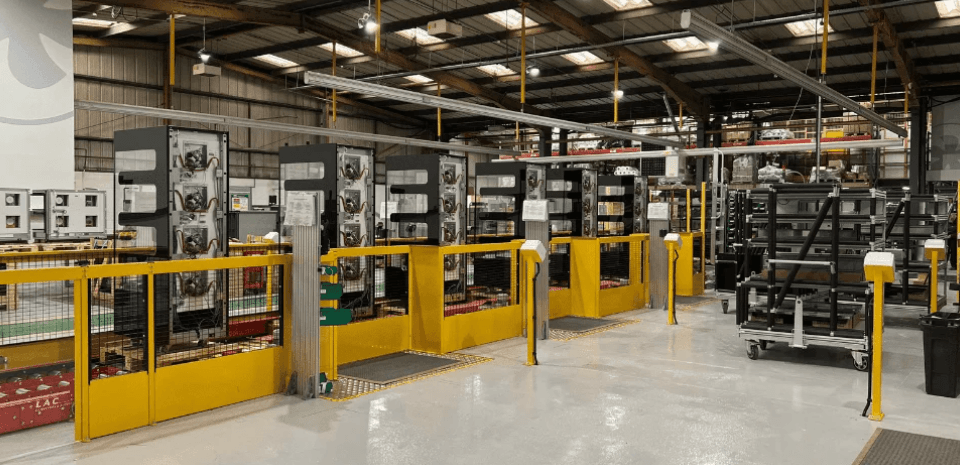
Modern facilities are designed around movement. Products, components, packages, and materials need to travel between different stages of production, storage, inspection, and distribution without unnecessary delays. As facilities become more automated and available floor space becomes increasingly valuable, traditional straight conveyor layouts are not always enough. Flexible conveyor systems are helping businesses create more adaptable routes while making better use of the space available.
Unlike fixed transport arrangements that require every process to follow a predetermined path, flexible conveyor solutions can be incorporated into layouts with curves, changes in direction, and varying production requirements. This adaptability is becoming increasingly relevant as manufacturers, warehouses, and distribution centres redesign their operations around automation.
Why Flexibility Matters in Material Movement
A production or distribution facility rarely has unlimited space. Equipment, workstations, storage areas, safety zones, and access routes all compete for the same floor area. Designing a conveyor system therefore involves more than simply connecting two points with a straight belt.
Products may need to move around machinery, change direction between processing stages, or transition from one section of a facility to another. Flexible conveyor systems can help accommodate these requirements without forcing the entire layout into a straight-line configuration.
This can provide greater freedom when planning or modifying a facility. Instead of treating the conveyor as a rigid pathway, designers can consider the overall movement of products and determine the most practical route.
Improving the Flow of Products
Efficient material movement depends on more than conveyor speed. The way products travel through a facility can influence bottlenecks, handling requirements, and how effectively different stages work together.
A flexible conveyor layout can help connect areas that are not positioned directly opposite one another. Curves and turns allow products to change direction while continuing through the same automated flow.
For example, a product might leave a processing machine, travel around another piece of equipment, and then enter an inspection or packaging area. A properly designed conveyor route can connect these stages without requiring unnecessary manual transfers.
Making Better Use of Floor Space
Space optimisation is one of the major reasons flexible conveyor technology is gaining attention. A straight conveyor may require a considerable amount of open floor space, particularly when several production stages are positioned at different angles.
Curved conveyor sections can allow manufacturers and warehouse operators to route products around existing equipment and use previously difficult-to-access areas. This does not automatically mean that every facility can reduce its footprint, but it gives designers more options when working within spatial limitations.
For facilities undergoing expansion or modernisation, this flexibility can also make it easier to integrate new equipment without completely redesigning the existing material-handling system.
Supporting Automation
Automation depends on predictable product movement. Robots, scanners, packaging machines, inspection equipment, and other automated technologies often need products to arrive at specific locations and intervals.
Flexible conveyor systems can form part of this connected workflow by moving products between different automated stations. In applications involving directional changes, a Flex-Turn Conveyor can help maintain continuous product movement while guiding items around corners.
The exact conveyor design depends on factors such as product dimensions, weight, speed, spacing, and the required turning radius. These considerations determine how the conveyor should be configured to maintain stable movement without damaging or misaligning products.
Reducing Unnecessary Product Handling
Every time a product is manually transferred from one conveyor or process to another, there is potential for delays, damage, or inconsistent handling. Automation can reduce some of these interruptions by allowing products to travel continuously between connected stages.
Flexible routing can be particularly useful when different processes are arranged across a facility rather than along a single straight line. Instead of introducing additional transfer points simply to change direction, a suitable conveyor arrangement can help maintain a more continuous flow.
This can be valuable in environments where product handling needs to be minimised, including food processing, packaging, manufacturing, and distribution.
Flexibility for Changing Facilities
Modern facilities do not necessarily remain unchanged for decades. Production volumes can increase, new equipment can be installed, and product ranges can change. A conveyor layout that works well today may need to accommodate different requirements in the future.
Flexible systems can provide additional options when facilities are modified. Depending on the conveyor design, sections can be integrated into new routes or reconfigured alongside other equipment.
This adaptability can be especially useful for businesses operating in industries where demand changes quickly. Rather than designing exclusively around current requirements, facility planners can consider how the material-handling system might support future changes.
Reliability Still Matters
Flexibility should not come at the expense of reliability. A conveyor system must still provide stable movement, appropriate load support, and consistent performance under its intended operating conditions.
Components need to be selected according to the application, including the type of products being transported, operating speed, temperature, cleaning requirements, and expected usage. Regular inspection and maintenance are also important for identifying belt wear, alignment issues, damaged components, or other potential problems.
A flexible conveyor is ultimately most useful when it combines adaptable routing with dependable day-to-day operation.
The Future of Flexible Material Handling
As facilities become more automated, the ability to adapt product movement to changing layouts will become increasingly important. Robotics, artificial intelligence, machine vision, and connected monitoring systems are influencing how modern facilities operate, but all of these technologies still depend on physical systems to move products between processes.
Flexible conveyor technology can provide that physical connection while giving facilities greater freedom to design efficient routes. Instead of viewing material movement as a fixed straight path, businesses can increasingly approach it as an adaptable part of the overall facility design.
See also: Spanish Test Online: Find Your Level Before You Enroll
Conclusion
Flexible conveyor systems are changing material movement by allowing products to travel through facilities that may include complex layouts, limited floor space, and multiple automated processes. Curves, directional changes, and adaptable configurations can help connect different stages while reducing unnecessary handling and providing greater freedom during facility planning.
As businesses continue to invest in automation and smarter production environments, conveyor technology will need to become equally adaptable. Solutions developed by companies such as Wirebelt demonstrate how specialised conveyor engineering can support this shift toward more flexible and efficient material movement. Ultimately, the most effective system is one that fits the facility, the product, and the processes around it while remaining reliable as operational needs evolve.